
|
About | Features | Reviews | Community | Screenings | Archives | Home |

September 2004
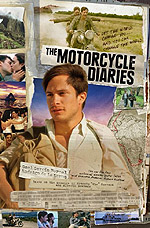
Motorcycle Diaries: An Interview with Gael Garcia
|
| (September: Main Page * Features * Reviews * Screenings * Teen ) Current Issue * Archive |
| Motorcycle Diaries: An Interview with Gael Garcia By Caroline Memnon
How helpful were the books (The Motorcycle Diaries, by Ernesto Che Guevara, and Traveling with Che Guevara, by Alberto Granado) for your character preparation? GGB: I read both books, they were the platform of everything, one is a more spiritual journey or account (that's Ernesto's) much more lyrical and the other is a better chronicle in the form of a journal with a very good sense of humor. 
You played Che Guevara before in the Fidel T.V. series, how did that role inform this younger Che you plyed in this movie? GGB: The past series was full of good intentions, but the only thing it did is pay the rent and make me want to do it again. Now to do it again, sometimes that doesn't come very often and I never really thought about it, until Walter came and there was the opportunity to make it, so this time it was we better do it good, we better learn. Did Walter Salles approach you with this project? GGB: Yes, he came to me. He wanted to meet me to talk about this project. As soon as I heard it, I knew I was going to not only say yes, but hoping that it was going to be a proposal and indeed it was a proposal. He proposed to me to be in it. You and Rodrigo have great chemistry in the film. Did you guys know each other beforehand? GGB: We met for the first time for this film. But I mean
I spent 4 months in argentina, preparing the part and d Was the equipment difficult to transport throughout the Journey? Extras who did you use? GGB: It was very small so it was very free, which permitted us to move from location to location. In terms of extras, surprisingly the social problematic of Latin America is pretty much the same as it was 50 years ago. What sort of pre GGB: The preparation for the character was 4 months, having
read all the biographies on Ernesto Guevarra and then we read everything
that he wrote, because he documented his life very much, his ideal are
well placed, he has a beautiful lyrical way of writing. We when to Cuba
we visited Ernesto's family and his friends, and the people that knew
him from Congo, Bolivia who fought with him. Alberto Granado spoke of
him, we read what they were reading at the time, Faulkner, Camus, we listen
to the music they were listening at the time, we learned how to ride on
a motorcycle, I worked out everyday, because he was a bit stockier. We
did lot of preparation. we did seminars on the political, cultural, and
economic situation of Latin America, specifically Argentina Chile, and
Peru, seminars on leprosy, a lot, a lot. When we finally arrived to filming
we realized that we were only 30% ready. I felt that is wasn't enough
because this story needed our experience of the journey to be able to
give life to the characters.We got to the point of sharing that experience
with the characters and we dis In light of things going on around the world today, do you think that Che's message is lost to the interest of first world countries? GGB: The fact that his message is still there, thanks in
part to his struggle in a way, it was an awakening of consciousness that
came in a very violent way, but that definitely marked us and made us
the people who we are. I know now that there are certain things that I
won' |
| (September: Main Page * Features * Reviews * Screenings * Teen ) Current Issue * Archive |
 |
|
Terms of Use
| Privacy
Policy Copyright © 1999-2004, BlackFilm.com
|
 oing
the work of preparing for a journey. For the journey was going to tell
the story. The journey gave us the kind of truth and the experience for
us to tell this kind of story.
oing
the work of preparing for a journey. For the journey was going to tell
the story. The journey gave us the kind of truth and the experience for
us to tell this kind of story. 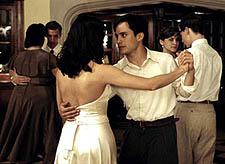 paration
did you do for the character? And what was your personal experience following
Che's journey through Latin America ?
paration
did you do for the character? And what was your personal experience following
Che's journey through Latin America ? 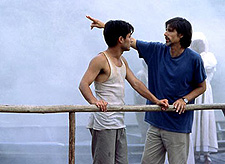 covered
thru this journey the social problematic of latin America is the same,
surprisingly things have not changed for good and they have not changed
for bad. They are still people that only speak Quechuan and in the political
structure that exists, still someone who does not speak Spanish is considered
underdeveloped, I don't know the Germans in Latin America don't speak
Spanish and they are not considered underdeveloped. Their still needs
to be a process of realizing and getting to know the people of America
and recognizing their languages and their culture and not letting this
stupefied globalization of mercantilism that doesn't respect the culture
languages people environment, etc. it was inevitable that this journey
would affect me.
covered
thru this journey the social problematic of latin America is the same,
surprisingly things have not changed for good and they have not changed
for bad. They are still people that only speak Quechuan and in the political
structure that exists, still someone who does not speak Spanish is considered
underdeveloped, I don't know the Germans in Latin America don't speak
Spanish and they are not considered underdeveloped. Their still needs
to be a process of realizing and getting to know the people of America
and recognizing their languages and their culture and not letting this
stupefied globalization of mercantilism that doesn't respect the culture
languages people environment, etc. it was inevitable that this journey
would affect me. 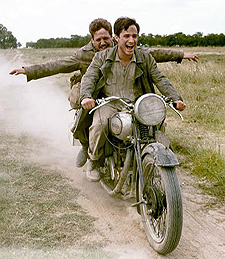 t
compromise, there are certain things about my culture that's the only
thing I have, you know. I know I will never put that on the line and let
it be destroyed in a way. You know. What I mean by that is I think his
ideology and struggle is still incredibly resonant and not only that,
I think it is going to become even more. There is a reason why this filmed
happened, this journey for a search of identity suddenly exists, it offers
a way out, the way way out form my perspective is not necessarily choosing
the correct political party, which are so far away from people, they obey
other rules, they don't obey the rules of the people , the environment
. And so this film puts onto the table the basic question of which side
of the river you want to live in. you want to live on the side that is
better or you want to live on the side where you should live where your
duty is, to make a change and by doing that it shows that the real politics
is one that you eat that you spit that you breathe in every day, that's
the real change that can happen. I think che's ideology is not lost but
coming back way bigger. We've seen in such a short period of time how
perceptions change, and we want other ways. We see how the solutions that
they've given us are completely wrong.
t
compromise, there are certain things about my culture that's the only
thing I have, you know. I know I will never put that on the line and let
it be destroyed in a way. You know. What I mean by that is I think his
ideology and struggle is still incredibly resonant and not only that,
I think it is going to become even more. There is a reason why this filmed
happened, this journey for a search of identity suddenly exists, it offers
a way out, the way way out form my perspective is not necessarily choosing
the correct political party, which are so far away from people, they obey
other rules, they don't obey the rules of the people , the environment
. And so this film puts onto the table the basic question of which side
of the river you want to live in. you want to live on the side that is
better or you want to live on the side where you should live where your
duty is, to make a change and by doing that it shows that the real politics
is one that you eat that you spit that you breathe in every day, that's
the real change that can happen. I think che's ideology is not lost but
coming back way bigger. We've seen in such a short period of time how
perceptions change, and we want other ways. We see how the solutions that
they've given us are completely wrong.