
|
About | Features | Reviews | Community | Screenings | Archives | Home |

December 2004
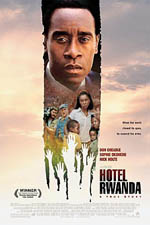
Hotel Rwanda: An Interview with Don Cheadle
|
| (December: Main Page * Features * Reviews * Screenings * Teen ) Current Issue * Archive |
|
By Wilson Morales
What attracted you to this project? Don Cheadle: Everything about it was attractive, from the role to being able to tell a story that really relatively few people are aware of. It's shocking but true. Just to have this kind of experience was great, and meeting Paul and his family. Terry was also a great director. It's just been all positive, you know. How close did you work with Paul to get his mannerisms? DC: We spent a pretty good deal of time together at the beginning
of the movie. When I knew I had the movie, we started emailing each other
back and forward and started talking on the phone. I watched a lot of
interviews because Terry actually took Paul back to Rwanda. It's the first
time Paul had been back to Rwanda and filmed all of his stuff, so I was
kind of voyeuristically taking notes and watching him. Then once we got
together it was just a lot of, you know, hanging out and going to dinner
and getting drunk and telling stories. I was kind of sitting at his feet
and getting more of a feel for, I guess, just kind of his character. I This is really the first time audiences get to see your abilities, unlike in Boogie Nights or Ocean Eleven. How do you feel about that? DC: You know, I have no idea and maybe I should be more methodical about that. I just kind of try to get involved in the kinds of films that make my part, you know, brace and I go "Oh my God, that would be terrifying" and "I don't know if I can do it." Those are the kinds of things I want to be involved in, and I don't know that this film will change anything but that wasn't really the thrust per se-- I wanted to do it in the beginning. Is there an extra responsibility on your part when you're playing somebody you've met? DC: Who might get on camera in front of national audience
and say I blew it (laughing). Yeah, I guess there's an extra little weight
involved and Thank God it was Paul and Thank God that we had his involvement
from the beginning. He wasn't someone that we tried to keep in the shadows
and not involve in the process, and "Just let us tell the movie and we'll
check in with you every once in a while." He was there on the set and
you know, really involved in how the story unfolded and this was something
that had been in development for years, so that was a lot of time that
he had to deal with the story. Umm, yeah, it's a little daunting when
he's sitting behind the monitor when you're doing a scene (laughing) and
you're looking at his face tryi Did you come home after shooting a certain scene and still deal with it? DC: Yeah. Every day. Yeah, every day there was some kind of decompression that I needed to do. Obsessing about every single detail, obsessing about, you know. I think it is an actor's lot anyway to sort of obsess about that kind of stuff. You know, what have I done that day, what beat did I miss, something. Then I'm gonna have to go back and get in another scene. Every night on the phone after work, Terry and I were talking about the script and trying to plot the week, plot the way, when do we want to do this scene cause we haven't yet done this scene, and you need to experience this scene emotionally before we try to have you do this scene, etc. So it was always that sort of a juggling act. But it was the biggest part I've ever done and I didn't realize until doing this part how intricately involved a lead actor is in every aspect of the story, you know. Do you try to balance bad guy and good guy and hero roles? DC: No, it's not that plotted. I don't look at it and go "Ok I did it this kind of guy and now I need to do this kind of guy." Usually I'm just responding to material and there's not a lot of good scripts, period. So usually if I read something and go "Oh that's interesting" or if I read and go like "I said that gets my pulse up and I feel like that's gonna be really difficult and I'm gonna be uncomfortable and scared and I don't know if I'm gonna do it", those are usually the ones you're supposed to do, you know. The ones like, man I could really blow it, you know. Did you film this m DC: That one came first. That one was first and then this one. You know what, I tell you honestly I get the order out of, I don't know, because I did five movies over the last year and a half, over four different continents and I wake up you know, is this Toronto, no it's New York. Ok we're in NY. Seems like you have proclivity for doing crime caper heist flicks? DC: No, it's not. It's just that those tend to make more noise. I mean everybody knows about Oceans 12 cause a million and a half people are in it, you know. I did three smaller movies during that time: The United States of Leland, Assassination of Richard Nixon, and Manic. I've done a lot of films they just don't make as much noise. They're small, they're indies, you know. Are you directing Tishomingo Blues? DC: Yeah, that's something that's still in the process. We didn't land any of the dough yet to make that. It's still in the works. In terms of directing, is it harder as a black actor to raise the money to do a film? Or is it easier because you're well known? DC: No, it's not. It's all about, look they have it broken
it down to the foreign market and whose gonna buy at foreign and how much
territories are being sold. That's what drives everything as far as American
movies go. Studio movies and to a large degree Indie movies are driven
by the foreign sales component. So you need a star, or stars on a certain
pedigree or scale that can guarantee that you can sell to Italy, London,
Japan, the UK-- all these places that are really where the market is.
Domestic market is a small part of the film's money. And it's difficult
because what alway How does that help with the market? DC: Let's hope it helps a lot. I mean personally, the buzz for me personally, I'm like "whatever" about it, but for the film I'm getting buzz and that brings attention to the film that's brilliant. And to that end, I welcome all of that, because I think there's a lot of good work in the film. I think that about the film itself, people are potentially apprehensive about seeing something that they know is based in Rwanda, they know it's a genocide but interestingly the MPAA gave it an R rating. And Terry and I had to go to the appeals board and appeal to get it a PG 13 rating and once the appeals board heard our argument they decided in 10 minutes to give us the rating because really, what were they judging it on? What were they basing it on? There's no overt violence. There's no strong sexual content, there's no foul language: Everything that they earmark as being the reason that it gets an R. They gave it an R because of just overall emotional impact which we said you can't really, you know (laughs). Isn't the emotional impact the ultimate goal of the movie? DC: Ye What surprised you the most about the situation in Rwanda? DC: I think what surprised me the most about it was how it was set up. I mean, how the situation was initially sort of built to come apart as it did. The Belgians decided who was going to rule who and picked people based on their features and using the minorities Tutsi to control the majority Hutu, and when they left they flipped it and gave the power to the majority. I mean, I don't know, that could be careless but it sounds very Machiavellian at the same time and like designed to keep a region unstable and it's continued. You know, it's just a cyclical thing. You know in this movie it ends with the Tutsis coming in and pushing all the Hutus out. It's 2 million people, the largest exodus in modern history, the exodus from Rwanda by the Hutus and the Tutsis that were still scared. But then when the Tutsi rebels came back in, they exacted horrible reprisals on all the Hutus who had put them in that situation, and they're still nipping at the edges and coming out of the mountains now. And there are small attacks every few weeks now and it's just diabolical. What's more important-- getting the scene right or thinking about the whole story itself? DC: No, getting the scene right. I mean getting, doing, which
is funny because that's kind of what Paul is trying to do every day, was
get the scene right. He wasn't thinking about when, you know, when people
ask Paul, "Oh you're a hero, and what did you do to plan everything and
what did you rely on?" He said, "I don't know what you're talking about."
He was like "Every day I had to do the thing that was in front of me.
There was no time to plan. There was no time to plot. There was no design.
It was set 'em up, give them some drinks, keep them away from them." Keep
them away from them, you know. He said it was as if you had a cat and
a mouse in a box, you know and you were constantly trying to figure o It's almost an old-fashioned adventure romance, with good guys triumphing over the bad guys. Is that what you feel is so remarkable about it? DC: Yeah, exactly. That's how it needs to be told, that's how it needs to be sold, that's how people need to go out there with what this movie is because otherwise you're like, "Oh, God, genocide, I don't know if I can" and I understand it, you know. That's what you want to do on a Friday night, go see a movie about the genocide. No. But you do want to see a movie where you see a good person triumph over insurmountable odds, and have a love story in its core. I think that's entertaining if you can use that word for this movie which I think you can. It's entertaining. Some people may pigeonhole this movie as a black film, but it has a lot more to it. What do you think of the state of black cinema? DC: I don't even know how that term is used really because
we're not talking about the 70s or even the early 80s where there was
a real sort of collective idea of black moviemaking. I don't see that
much any more. There are very few black directors who are able t Were you aware of the Rwanda situation before the film? DC: Yes, I was because I saw a frontline piece about it which really, took it in detail and really described it, which was unbelievable. Now that's hard to watch. Will you make an effort to bring this movie into schools? DC: Yes, we will. We are because that was one of the big fights to get it to be PG 13. When I was 13 years old, I remember I saw a film in junior high school called Night and Fog, which is a documentary about the holocaust and very graphic and very, you know, just stark documentary about a lot of footage. It was a very humanizing thing for me. It actually jump-started my thinking about the world in a way I had not thought about it before. Not just the horrors that are possible, but that "Oh my God, people do that to people out there in the world." It just turned on a whole way of me thinking about the world. It didn't crush me. It wasn't overwhelming to the point that I couldn't go on and it gave me nightmares but it did really stick with me until this day. It's probably a big reason why even now I'm inspired to do something and I'm more humanistic because of it. Hopefully this film could do that same thing for someone developing their ideas about the world. What's your role in Crash? DC: I produced the movie. What's my role in the film? I play a detective in Grand
Waters.
|
| (December: Main Page * Features * Reviews * Screenings * Teen ) Current Issue * Archive |
 |
|
Terms of Use
| Privacy
Policy Copyright © 1999-2004, BlackFilm.com
|
 wanted to do some particular characteristics but I was more trying to
just get a feeling for who he was as a man, you know, his spirit.
wanted to do some particular characteristics but I was more trying to
just get a feeling for who he was as a man, you know, his spirit.  ng
to interpret is that a frown, is that a grimace, is that a smile you know,
and finally-- Just get him out of there and take him to the lunch trailer
or something. Get him a sandwich and let me do this scene, you know.
ng
to interpret is that a frown, is that a grimace, is that a smile you know,
and finally-- Just get him out of there and take him to the lunch trailer
or something. Get him a sandwich and let me do this scene, you know.  ovie
or Oceans 12 first?
ovie
or Oceans 12 first? 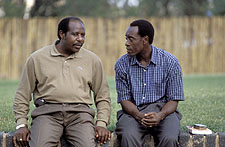 s
comes back for black actors is your movies don't sell well overseas. But
I know that. I know a person whose job it was to sell movies overseas
and he said we don't even pull the black movie out of the briefcase a
lot of times because you know it's a hard sell. People don't understand,
we get a little resistance so we don't push that one. It's like, well
nothing sells itself except Oceans 11, you know, except movies like that.
So yeah there's a lot of nuisance reasons why things, a lot of those things
become difficult. Even if you're doing a movie where you're directing
a movie and you have a white lead, the white lead still has to be of a
certain caliber that they believe is going to generate the dollars commiserate
with what your budget is. That's always a balancing act, it's always cut
more, get a bigger name, you know. That's always the kind of battle cry--
cut more, get a bigger name.
s
comes back for black actors is your movies don't sell well overseas. But
I know that. I know a person whose job it was to sell movies overseas
and he said we don't even pull the black movie out of the briefcase a
lot of times because you know it's a hard sell. People don't understand,
we get a little resistance so we don't push that one. It's like, well
nothing sells itself except Oceans 11, you know, except movies like that.
So yeah there's a lot of nuisance reasons why things, a lot of those things
become difficult. Even if you're doing a movie where you're directing
a movie and you have a white lead, the white lead still has to be of a
certain caliber that they believe is going to generate the dollars commiserate
with what your budget is. That's always a balancing act, it's always cut
more, get a bigger name, you know. That's always the kind of battle cry--
cut more, get a bigger name.  ah,
exactly. That's the whole point of the film and the reason that no one
did anything in the first place is because of its strong emotional impact,
and they didn't want to deal with the news. Too big. Don't do it again
to the movie, what happened to them in actuality.
ah,
exactly. That's the whole point of the film and the reason that no one
did anything in the first place is because of its strong emotional impact,
and they didn't want to deal with the news. Too big. Don't do it again
to the movie, what happened to them in actuality.  ut
a way to negotiate with the cat not to eat the mouse, and that's what
he was doing day to day. So in a great microcosm, it was a great thing
to have that kind of perspective on the story, because I think that's
how the story was written. I think it's been done very well to not try
and get your arms and your head around the whole idea of the genocide
because how can you, you know. And how can you in a two hour movie. You
can't. And if you'd tried to, it would've failed miserably. But to tell
the story of one man and his love for his family and in that regard the
movie is really a thriller, you know and with a love story at its core.
Everyone that has seen this film at the screenings we've showed has come
out of it saying they were apprehensive at first and a little, you know,
nervous about what they were going to be seeing but ultimately they were
overwhelmed. It was very heart warming for them and encouraging which
is a great, great result.
ut
a way to negotiate with the cat not to eat the mouse, and that's what
he was doing day to day. So in a great microcosm, it was a great thing
to have that kind of perspective on the story, because I think that's
how the story was written. I think it's been done very well to not try
and get your arms and your head around the whole idea of the genocide
because how can you, you know. And how can you in a two hour movie. You
can't. And if you'd tried to, it would've failed miserably. But to tell
the story of one man and his love for his family and in that regard the
movie is really a thriller, you know and with a love story at its core.
Everyone that has seen this film at the screenings we've showed has come
out of it saying they were apprehensive at first and a little, you know,
nervous about what they were going to be seeing but ultimately they were
overwhelmed. It was very heart warming for them and encouraging which
is a great, great result.  o
get their movies greenlit and they're not as far as I can tell, there's
no thematic sort of synergy. It's just like this guy got his film made
and this guy, everything's happening so people are all in their own little
island because there's such a corporate mentality at the studio levels
now that every thing about films is about the bottom line, you know. Like
I told you about the foreign, how foreign markets are driving these films
now and everything is geared toward repeat ticket buyers, who are none
of us in this room, you know. Everybody in this room, we'll see a movie
and go "Oh man, I gotta see that some day." That's interesting. We're
not going, "I gotta be there first in line, Friday night, me and my seven
friends and we're gonna go see this movie." That's who they're trying
to get in the audience because those guys go see the movie 6 times. You're
gonna see it once on cable if it looks interesting to you. So it's hard
to balance that art, that question of art and commerce and it's even a
smaller niche when you're talking about black films, you know.
o
get their movies greenlit and they're not as far as I can tell, there's
no thematic sort of synergy. It's just like this guy got his film made
and this guy, everything's happening so people are all in their own little
island because there's such a corporate mentality at the studio levels
now that every thing about films is about the bottom line, you know. Like
I told you about the foreign, how foreign markets are driving these films
now and everything is geared toward repeat ticket buyers, who are none
of us in this room, you know. Everybody in this room, we'll see a movie
and go "Oh man, I gotta see that some day." That's interesting. We're
not going, "I gotta be there first in line, Friday night, me and my seven
friends and we're gonna go see this movie." That's who they're trying
to get in the audience because those guys go see the movie 6 times. You're
gonna see it once on cable if it looks interesting to you. So it's hard
to balance that art, that question of art and commerce and it's even a
smaller niche when you're talking about black films, you know.