|
About | Features | Reviews | Community | Screenings | Archives | Home |

October 2007
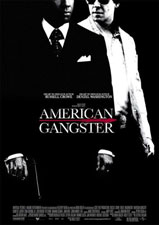
AMERICAN GANGSTER
An Interview with Denzel Washington & Russell Crowe |
| (October: Main Page * Features * Reviews * Screenings * Teen ) Current Issue * Archive |
|
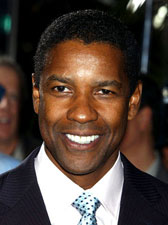
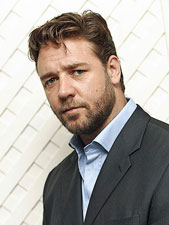
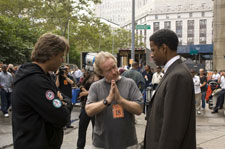
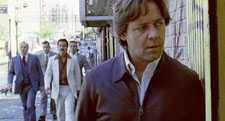
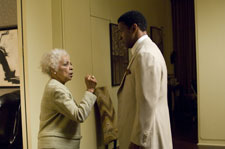
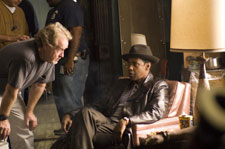
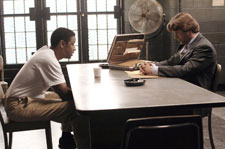
October 26, 2007 When you have two heavyweights in a film, all you want to see is a good fight. The same theory applies when you see a film that actors at the highest of the game. Twelve years, Denzel Washington and Russell Crowe did a sci-fi film called ‘Virtuosity’ that was poorly conceived and savaged by critics. Both actors were relatively young in their careers, although Denzel had his first Oscar by that time. Certainly enough time has gone by where both of these men have excelled in their craft and Russell is also a Oscar winner. To have these two in the same film is almost as equivalent to when Robert De Niro and Al Pacino faced each other in ‘Hear’. Their characters were on opposite side of the law, one for it and the other against, which is what we have here in “American Gangster’, the story of Harlem druglord Frank Lucas and the man who brought him down, Ritchie Roberts, and helped him turn state evidence on many of his colleagues. In a recent press conference in New York City, both Washington, who plays Lucas, and Crowe, who plays Roberts, spoke about the gangsters and drugs of that era and of their characters and working with Ridley Scott. Can you talk about the delicate balance between good versus evil that we see so clearly between your two characters? Denzel Washington: Now, who was the good guy and who was the evil guy? That's the delicate balance. One could say that the cord runs parallel to both. DW: And there you have it. The cord runs parallel to both. Jump in there, Russell. Russell Crowe: Well, I think that's one of the fascinating things about the two characters and about the story itself. That none of that's clear. There's not a clear singular morality, and when you get the opportunity to play that sort of thing, which is nothing more than reality and the sort of humanity as it exists. It's just a bit of fun. Richie's an honest guy and all that sort of thing, but as his wife calls him out in the court: you're only honest in one area; you try and buy yourself favorites for all the shit that you do. I just think that's an honest appraisal of who he was as a man at that time, but it also leaks into that area of discussing why people go bad in the first place, or what the process of Frank Lucas was to become a drug dealer. If Frank Lucas had been befriended by somebody else and educated in a different area, he might get in a situation where a university's named after him. He's a very smart guy and he uses things that he's learned to the best of his ability to change his life and change the life of his family at that time. But it just happened to be that Bumpy Johnson was his teacher. We were joking yesterday about doing his sort of course work on the street, PhD in criminality under Bumpy Johnson. DW: Yeah. Denzel, there are a few rappers in this movie and I was wondering about your reaction about a rapper making a gangster album and a actor making a gangster movie? Over the past year, guys like Al Sharpton and Oprah have been going against violence in hip hop album and different language, so the rappers get a certain rep, but in gangster movies, the actors are praised. How was wondering if you had an opinion on why there’s a difference? DW: In 2005, I did "Julius Caesar," so whenever any rapper's ready to do some Shakespeare, I'll be there. I can do both. So can they, if they can. So there is a difference. This is just one movie. It's not the only movie I've made. I'm not knocking rappers but... RC: I think what he was actually getting to, which is really pretty cool, is that he's saying that a guy comes out and he sings a song about his lot as a gangster or what his experience was. He puts it on a record, and people get down on him, but you and me, we make a movie about you being a gangster, and us in that world, and we get praised for it, in terms of, from a creative point of view. DW: Yeah, some rappers who have made gangster albums have gotten praise for it, too. Some real good ones. Real good ones. "America's Most Wanted" is still one of my favorite albums. RC: Is it the criminality that people are getting upset about with the music or is it the sort of male-female attitude kind of thing? I mean there's some of that sort of stuff, and you know you're actually literally singing the praises of gun worship, as opposed to a movie that plays out in DW: And these are the consequences. RC: There's definitely a difference there. The film takes place during the Vietnam war and we are living during the Iraqi war. What is your take of the moving or transportation of drugs and the revenue and the gangsters in society today compare to back then. DW: Who is the new American gangster? Oh man. They get voted in now. Next question. There's a strong tradition of New York crime films from "Naked City" to "The Godfather" and "Prince of the City." Where do you think "American Gangster" fits into that lineage? DW: Well, I can say for one, of all those films you mentioned, there's no black people in any of them. So for one, this is a Harlem story. This is about a guy who was a kingpin, about a different kingpin. I think the situation is basically the same. They were obviously different movies, but the business was the same, if it was based on the heroin business. As we were talking earlier, I guess to a degree, it's a genre. There are certain things that are similar in those kinds of films, but this one in particular, dealing with a guy from uptown. Denzel, Ridley (Scott) said that Frank (Lucas) is a very disturbed man and that he was on the set all the time and he said he would describe him as a sociopath. Can you talk about your interpretation of him? Is there something missing there? DW: Sociopath. I wouldn't say that about Frank. I didn't find that to be true. I think that as Russell was saying earlier, he's a man without a formal education, he's a man who at the age of 6 witnessed his cousin get murdered by sociopaths. RC: In uniform. DW: In uniform. Elected officials. And that changed his life. From a very young age he began to steal and he worked his way up the line. He came to New York and the most notorious gangster in Harlem recognized the talent, if you will, in this young kid, and he continued to train him. He was on the wrong side of the tracks, but he was a brilliant student, and became a master of the business that he was in. It's a dirty business. And he's definitely a criminal. He's responsible for the death of many people. So I don't want to just say that he's a product of his environment, but I guess to a degree we all are, and as Russell said, I think had he got a formal education, had he gone in another direction, had he had different influences, I think he still would have been a leader or a very successful man. You know he has a 10 or 12-year-old son now who's brilliant. But doesn’t the film glamorize him? RC: That's a sort of easy one to take head-on because quite frankly, large parts of Frank Lucas's life were very glamorous. The nightclubs, hanging out with Wilt Chamberlain, sports figures and celebrities of the time. His public persona as such was the guy that ran this nightclub. Everything else that fell down from that was not known. Wilt Chamberlain or any of these celebrities that were hanging out with him wouldn't have known that Frank was turning over a couple of hundred keys every mont DW: And they may have known that he still had the club where the chicks were. Both of you gentlemen have gotten so many accolades for your work. What inspires you to get up every day and do the work you do? DW: That was a good question. Professionally now, I've sort of started to head in another direction. Getting behind the camera, the second film I've directed now, and I'm sure that's my new career, but on a more basic level, I was just watching Russell with his little boy up front and that's part of the reason. I had to go to work so we could eat, but there's a lot of joy in that, just watching his face, playing with his son and his son just looking at his dad. Acting for me is making a living, it's not my life. My children and my family, that's life. The miracle of life. I'll get up every morning, God willing, for that. RC: I've always seen it to be a privilege to make movies. It's a really expensive, creative medium and people around me to do it. There's things that I can do as an actor that I couldn't do in any other form of life, and I've got a strange personality, but film requires strange people, so I've got a nice comfy home. That's what I do and I'm really happy with that. And when I know I'm getting up to go to work with Ridley and I know the time and effort he would have put into whatever it is that we're about to shoot that day, it’s all, to me it's just a great privilege, and every day I kind of look around and thank the lord that it's still going on, and I just get to work and do the thing I'm doing that day. DW: Yeah, me too. RC: He kept bringing them to the set. DW: I brought two of them. I brought them both Did you discuss working together again? RC: We didn’t talk about it. We didn’t talk about it at all. Brian was talking to me about it and saying there was a chance we could put it back together if we got X amount of people interested in it, so that's how the pursuit was begun, and I heard that Denzel was happy with the idea of doing it with me and obviously I was happy that I was doing it with him, so we didn't talk about it until we were on the set. "Hello, mate. How you doing? Good to see you again." And we were shooting that day. Didn’t you do the sci-fi film…. RC: "Virtuosity," yes. Wonderful movie. Just a momentary lapse, wasn't it? I know it's one of your favorites. We were both young then, young and innocent. DW: Not after that movie. Denzel, as a New Yorker, were you familiar with the story of Bumpy Johnson and Nicky Barnes? Did you learn anything while and after playin DW: Yeah, I think everybody heard about Nicky Barnes, and again it's a testament to Frank's business sense. You never heard about Frank Lucas. Nicky Barnes bought his dope from Frank Lucas, a lot of it. Some people were more interested in being in front of the camera and some more in just being behind, and Frank was many layers removed from the streets. If you can be on any TV show, which one would you choose and why? DW: I'd like to do "Lockdown," the prison documentary, that's one of my favorite shows. I don't watch TV. Unless I'm throwing a ball, I don't really watch any of these series shows. I couldn't tell you. RC: What do you think we should be on? What should we be fishing for? Maybe the two of you could be the new "Odd Couple"? DW: You've got a future in this business. That's a good idea. RC: You'd have to be Tony Randall though. DW: I'd have to be Tony Randall. I have to be the neat one? RC: Yeah, you do. DW: And you expect me to be the neat one? Am I the neat one in this movie? RC: Yeah. Denzel, Were you at all hesitant about playing another dark character after ‘Training Day’? Did you think how you were going to flip the script with the next character? DW: I wasn't hesitant at all. A good story is a good story. I just think again that before "Training Day," I hadn't really been offered that kind of role. After "Training Day," that was all I was offered. No, that's not true, but I was offered more of that kind of thing, but it just comes down to good material, great actor to work with and great filmmaker. It wasn't that complicated, at all. ‘Great Debaters’ is an entire different story. We tested the film up in the Bay Area last week, and it tested through the roof. People loved it and it had a great ovation at the end of the film. It's a wonderful film for great young actors like Nate Parker and Jurnee Smollett and a young man named Denzel Whitaker, if you can believe that, and Jermaine Williams and they all give brilliant performances and Forrest Whitaker and myself are in the film as well. So I'm very happy about that film. It's a completely different film from this and I'm proud of it. New York today seems to be a lot less corrupt… DW: Obviously, you don’t live here. Crime is supposedly down in New York, but this was definitely a period of corruption in terms of the police and gangster of the day. What were your insights to the gangster and police of that era? Did you do any rese DW: (looking at Crowe) You know more about the police. RC: I get all the shitty ones. DW: Okay, I’ll go first. Maybe it's cliché, but I think there was more honor among thieves in those days. There was a sort of code of ethics. We didn't hear about Frank killing kids and that kind of thing, and drive-bys and all of that. He's a very interesting man. He was very much a family man, and believed in sitting down at Thanksgiving with the family and all of that. He was in the drug business. I don't think he looked at himself as a killer or even a criminal. He was in a business, he sold the product, and he did a good job at it. RC: I don't think anybody wants zealotry in their police force. There's always got to be room for what you might call benign corruption. Nobody blames a man who steals food to feed his starving children, but on the other hand somebody who picks up a badge and takes an oath to serve and protect, we do expect a certain level level of essential honesty. I mean you're going to be put in situations as a policeman that require you to function and observe without necessarily getting involved, and taking the money from drug operations and all that sort of st Did you learn anything from directing "Antwone Fischer" and how to deal with the problems you had with its marketing? What might you do differently with this one? DW: That had a problem with marketing? To be quite frank with you, one of the things I've learned from that first go-round is that I'm popular, so if you do the Oprah Winfrey show or The Today Show or this or that or The Tonight Show, and you tell people the film's coming out on Friday, but in fact it's platformed and only coming out in two theatres, it's a mistake. So we're not coming out in two theatres, we're coming out in 2,000 or something right away, and not to knock the marketing guys or whoever, because I was as much a part of that as they were, but I think that's something we'll do differently this time. My mother was calling me and “Everybody's calling me. You said the movie's coming out, well where is it?” I said, "Well, it's in New York and one theatre in L.A.” “Folks don't understand that. You told them it was coming out tomorrow!" she would say, “Alright, Ma. I’ll go make some copies” AMERICAN GANGSTER open
|
| (October: Main Page * Features * Reviews * Screenings * Teen ) Current Issue * Archive |
 |
|
Terms of Use
| Privacy
Policy Copyright © 1999-2007, BlackFilm.com
|
 AMERICAN GANGSTER